Author
Vivian Conan
Published
May 27, 2026
Tags
“Can you grab the horizontal line with your mouse and pull it down?” Sydney asks. I do. “Let’s make it 50,” she says. I click on 50. “Good.” I’m so focused on executing her instructions that it takes me a moment to remember why we did this. The audio track on the video we’re creating was too loud. We just lowered the volume by 50%.
Electronically Savvy—For an Octogenarian
I’m considered electronically savvy for an octogenarian. At work, I show library patrons using our public computers how to attach files to their emails, and in my independent-living residence, I teach my neighbors how to use the Libby app to borrow ebooks. But creating posts for social media was beyond me, so I signed up for Tech Coaching with DOROT. They paired me with Sydney, a volunteer in her twenties.
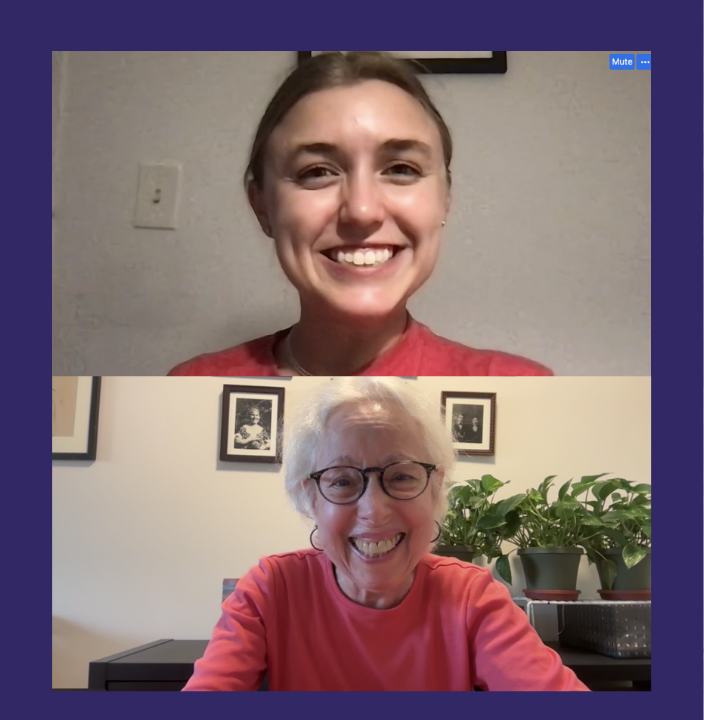
During our first meeting on Zoom, I explained that I had written a memoir about healing from mental illness and wanted to create videos about it to post on Instagram.
“Do you have an Instagram account?” Sydney asked.
“Yes,” I said. “I signed up by mistake during the pandemic. I wanted to get groceries delivered and thought I was enrolling in Instacart.”
She laughed.
My First ‘Reel’ Steps
Sydney grew up near Chicago and went to college in Utah. She has a master’s degree in health administration and was starting a new job in a medical center. I am a semi-retired librarian, born and raised in Brooklyn, and, like Sydney, now live in Manhattan. We agreed to continue with Zoom [note, DOROT now only offers Tech Coaching in person].
In preparation for our next session, I extracted a few clips from my audiobook. When we Zoomed, I found that Sydney, too, had been busy. Unasked by me, she’d read my memoir. I was touched, and glad to know she was all in.
That session defined the way we would work going forward.
Sydney told me what to click, and I followed her instructions. My initial impulse was to take notes, so when she wasn’t there, I could create something on my own. But from the first step, I found myself in a world so foreign that there was no way I could codify it. As if I were a child helping mommy bake, I simply poured the sugar and stirred in the chocolate chips when she said to, trusting we would wind up with cookies. To my amazement, by the end of that hour, we had a 53-second “reel,” as Sydney explained short videos are called. The sound consisted of the audio clips I had prepared. The visuals were my book cover and the text of what the audio was saying. I was thrilled, and, judging from her smile, so was Sydney.
From Card Catalog to Hashtag
After we made a few reels, Sydney taught me how to post them online. The process involved creating hashtags, which Sydney explained were terms people used to search for topics they were interested in. Just like subject headings in a library catalog, I thought.
To get an idea of how other authors use hashtags to promote their books, I suggested we look at the social media accounts of one of my friends, the former editor-in-chief of McCall’s Magazine. Sydney had never heard of McCall’s. Nor had she heard the term “women’s magazines” or known how popular they were in what was, to me, the not-so-distant past of the 20th century. I felt a sudden sense of loss, as if the bedrock beneath me had given way.
I began talking about card catalogs, telling Sydney that for each book, there was an an author card, a title card, and one or more subject cards. Whenever a book was removed from the collection, all its cards had to be manually pulled from the catalog drawers, a tedious task when there were many discards to process. She told me one of her college jobs had been in the library. She’d once been assigned to process a shelf of discards and found it tedious to sit with a computer and delete one entry for each book. I found that reassuring. Some things hadn’t changed.
A Digital Native and a Digital Immigrant
Sydney always seems interested in these glimpses into what, for her, is history. I, in turn, am fascinated by the way her mind works. Whenever we come to a stumbling block—say it’s not obvious how to make the sound fade out—Sydney’s eyes go off to the side and I can almost see the proverbial wheels turning. When her eyes snap back, she directs me to hover my mouse over this or that object, or to open another app. If nothing works, she enters a query on her phone and comes up with the answer. She is a digital native, at home with this scavenger-hunt method of finding answers. I am a digital immigrant, used to searching an alphabetical index of words. With Sydney as my guide, I am slowly changing my approach.
“How was your week?” Sydney asks as the start of each session. She begins eating her dinner—a cup of yogurt or a plate of something simple—as we check in. My cataract surgery. The NYC Marathon; she came in at 3:29! Then I click “Share Screen” and we get to work.
The one time we met in person, sharing not a screen but a table in a restaurant, I asked Sydney how she heard about DOROT. She knew she wanted to volunteer, she said, and searched online for something geographically close and no more than five hours a week—conditions that would ensure the likelihood of her continuing. DOROT’s mandate was 6-8 weekly sessions of one hour per week. At the close of our eighth week, I pointed out that we had reached the limit. “I don’t think DOROT would mind if we continued,” Sydney said. I was gratified she didn’t want to stop but checked with DOROT. Their response: If it’s working, by all means keep on. As of this writing, we’ve been screen-sharing more than a year.
A Refreshing Generational Difference
From occasional personal references, I know Sydney chose the University of Utah because she likes hiking and nature. One of her college jobs was a six-month stint as a certified nursing assistant, because she “wanted to see what it was like.” She lives with a roommate she found online, has a boyfriend, and likes to read. Her job in the medical center involves analyzing data, for example, the rate of readmissions in her hospital compared with readmission rates in nearby hospitals.
Sydney knows more about me, because she read my memoir, but aside from how to portray it in a reel, we don’t discuss it. She relates to the person I am at the moment, not the me in the book. In this, the generational difference is refreshing. Mental illness doesn’t carry the stigma with today’s young people that it used to.
I enjoy giving Sydney a window into details of the past that don’t make it into history books. I like to think we’re part of a human chain, that in future decades, an older Sydney will be navigating the next cognitive revolution with a guide as young as she is now, while she, in turn, explains the archaic phenomenon of social media to that young person. I never asked what she gets out of our relationship, but I can tell she enjoys it.
Recently, we were deciding which transition to insert between two segments of a reel: a curtain parting or a fadeout—refinements I had no notion of when we created our first reel. Sydney beamed at me, a teacher proud of her student’s progress, and said, “Remember in the beginning…?”
Learn more about Tech Coaching >
In addition to being a DOROT program participant, Vivian Conan is a writer, librarian, and IT business analyst.